Book/Screwtape Letters
Front Cover
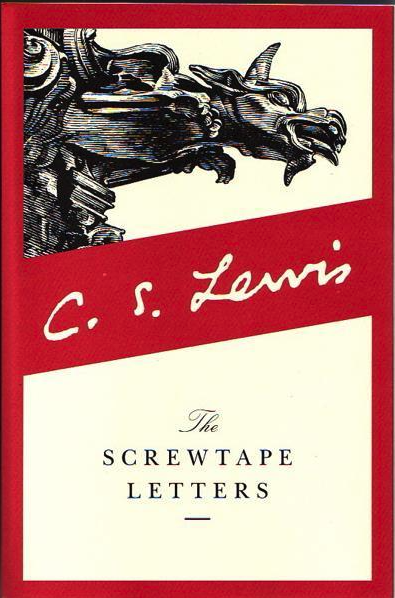
Opening Lines
I have no intention of explaining how the correspondence which I now offer to the public fell into my hands.
Contents
Epigraph
Preface
Chapter 1-31
Screwtape Proposes a Toast
Summary
This book is a collection of letters written to a "junior tempter" named Wormwood from his Uncle Screwtape. As you read, you'll learn something about the bizarre relationship between uncle and nephew and the mostly fictional description of the demon (or tempter) world. But beside these purely entertaining bits, you'll also learn from Lewis' unique take on spiritual warfare.
If you've read other non-fiction books from Lewis, you will find common themes in this one. But these themes are transposed into a harsh and dissonant tune. What Lewis normally speaks of as vile is described here as desirable. And what Lewis praises is described here as revolting. The "god" of the tempter's world is referred to as "Our Father Below", and the one true God is simply called the "Enemy". I think this is the most startling part of reading the book. It will probably take you a few chapters to get used to it.
After the book was published, Lewis said this about the process of writing it:
I was often asked or advised to add to the original Screwtape Letters, but for many years I felt not the least inclination to do it. Though I had never written anything more easily, I never wrote with less enjoyment. The ease came, no doubt, from the fact that the device of diabolical letters, once you have thought of it, exploits itself spontaneously, like Swifts big and little men, or the medical and ethical philosophy of Erewhon, as Ansteys Garuda Stone. It would run away with you for a thousand pages if you gave it its head. But though it was easy to twist ones mind into the diabolical attitude, it was not fun, or not for long. The strain produced a sort of spiritual cramp. The world into which I had to project myself while I spoke through Screwtape was all dust, grit, thirst and itch. Every trace of beauty, freshness and geniality had to be excluded. It almost smothered me before I was done. It would have smothered my readers if I had prolonged it. I had, moreover, a sort of grudge against my book for not being a different book which no one could write.
Thankfully, we do not have to live in this world like Lewis did for however long it took him to write the book. We just get to visit. And if you're planning a visit, prepare yourself for something an experience that is both comically entertaining and gravely serious. It will change your view of sin, temptation, and spiritual warfare. And it will also make you smile, which, I think, is also a part of effective spiritual warfare. It was Luther who said,
"The best way to drive out the devil, if he will not yield to texts of Scripture, is to jeer and flout him, for he cannot bear scorn."
I think he's right here. I think there is a way to laugh at Satan without being arrogant or frivolous. After all, we're not laughing at our own joke. We're laughing at a joke that's been making the rounds since the resurrection.
So if some of our more severe brethren accuse us of being a tad too flippant about something so serious, I think we can respectfully and accurately point them to Colossians 2:15 and say, "Don't look at me. Jesus started it."
Citations
Preface
There are two equal and opposite errors into which our race can fall about the devils. One is to disbelieve in their existence. The other is to believe, and to feel an excessive and unhealthy interest in them. They themselves are equally pleased by both errors and hail a materialist or a magician with the same delight. The sort of script which is used in this book can be very easily obtained by anyone who has once learned the knack; but ill-disposed or excitable people who might make a bad use of it shall not learn it from me.
Chapters/Letters
Your man has been accustomed, ever since he was a boy, to have a dozen incompatible philosophies dancing about together inside his head. He doesn't think of doctrines as primarily true or false, but as academic or practical, outworn or contemporary, conventional or ruthless. Jargon, not argument, is your best ally in keeping him from the Church. Don't waste time trying to make him think that materialism is true! Make him think it is strong, or stark, or courageous that it is the philosophy of the future. Thats the sort of thing he cares about.
Do what you will, there is going to be some benevolence, as well as some malice, in your patients soul. The great thing is to direct the malice to his immediate neighbours whom he meets every day and to thrust his benevolence out to the remote circumference, to people he does not know. The malice thus becomes wholly real and the benevolence largely imaginary. There is no good at all in inflaming his hatred of Germans if, at the same time, a pernicious habit of charity is growing up between him and his mother, his employer, and the man he meets in the train. Think of your man as a series of concentric circles, his will being the innermost, his intellect coming next, and finally his fantasy. You can hardly hope, at once, to exclude from all the circles everything that smells of the Enemy: but you must keep on shoving all the virtues outward till they are finally located in the circle of fantasy, and all the desirable qualities inward into the Will. It is only in so far as they reach the Will and are there embodied in habits that the virtues are really fatal to us.
I had not forgotten my promise to consider whether we should make the patient an extreme patriot or an extreme pacifist. All extremes, except extreme devotion to the Enemy, are to be encouraged. Not always, of course, but at this period. Some ages are lukewarm and complacent, and then it is our business to soothe them yet faster asleep. Other ages, of which the present is one, are unbalanced and prone to faction, and it is our business to inflame them. Whichever he adopts, your main task will be the same. Let him begin by treating the Patriotism or the Pacifism as a part of his religion. Then let him, under the influence of partisan spirit, come to regard it as the most important part. Then quietly and gradually nurse him on to the stage at which the religion becomes merely part of the cause, in which Christianity is valued chiefly because of the excellent arguments it can produce in favour of the British war-effort or of Pacifism. The attitude which you want to guard against is that in which temporal affairs are treated primarily as material for obedience. Once you have made the World an end, and faith a means, you have almost won your man, and it makes very little difference what kind of worldly end he is pursuing.
Never forget that when we are dealing with any pleasure in its healthy and normal and satisfying form, we are, in a sense, on the Enemy's ground. I know we have won many a soul through pleasure. All the same, it is His invention, not ours. He made the pleasures: all our research so far has not enabled us to produce one. All we can do is to encourage the humans to take the pleasures which our Enemy has produced, at times, or in ways, or in degrees, which He has forbidden. Hence we always try to work away from the natural condition of any pleasure to that in which it is least natural, least redolent of its Maker, and least pleasurable. An ever increasing craving for an ever diminishing pleasure is the formula. It is more certain; and its better style.
Flippancy is the best of all. In the first place it is very economical. Only a clever human can make a real Joke about virtue, or indeed about anything else; any of them can be trained to talk as if virtue were funny. Among flippant people the Joke is always assumed to have been made. No one actually makes it; but every serious subject is discussed in a manner which implies that they have already found a ridiculous side to it. If prolonged, the habit of Flippancy builds up around a man the finest armour-plating against the Enemy that I know, and it is quite free from the dangers inherent in the other sources of laughter. It is a thousand miles away from joy: it deadens, instead of sharpening, the intellect; and it excites no affection between those who practise it.
You will say that these are very small sins; and doubt-less, like all young tempters, you are anxious to be able to report spectacular wickedness. But do remember, the only thing that matters is the extent to which you separate the man from the Enemy. It does not matter how small the sins are provided that their cumulative effect is to edge the man away from the Light and out into the Nothing. Murder is no better than cards if cards can do the trick. Indeed the safest road to Hell is the gradual one the gentle slope, soft underfoot, without sudden turnings, without milestones, without signposts
Our business is to get them away from the eternal, and from the Present. With this in view, we sometimes tempt a human to live in the Past. But this is of limited value, for they have some real knowledge of the past and it has a determinate nature and, to that extent, resembles eternity. It is far better to make them live in the Future. Biological necessity makes all their passions point in that direction already, so that thought about the Future inflames hope and fear. Also, it is unknown to them, so that in making them think about it we make them think of unrealities. In a word, the Future is, of all things, the thing least like eternity. It is the most completely temporal part of time for the Past is frozen and no longer flows, and the Present is all lit up with eternal rays. Hence the encouragement we have given to all those schemes of thought such as Creative Evolution, Scientific Humanism, or Communism, which fix mens affections on the Future, on the very core of temporality. Hence nearly all vices are rooted in the future. Gratitude looks to the past and love to the present; fear, avarice, lust, and ambition look ahead. The humans live in time but our Enemy destines them to eternity. He therefore, I believe, wants them to attend chiefly to two things, to eternity itself, and to that point of time which they call the Present. For the Present is the point at which time touches eternity. Of the present moment, and of it only, humans have an experience analogous to the experience which our Enemy has of reality as a whole; in it alone freedom and actuality are offered them.
He's a hedonist at heart. All those fasts and vigils and stakes and crosses are only a facade. Or only like foam on the seashore. Out at sea, out in His sea, there is pleasure, and more pleasure. He makes no secret of it; at His right hand are pleasures for evermore. Ugh! I don't think He has the least inkling of that high and austere mystery to which we rise in the Miserific Vision. He's vulgar, Wormwood. He has a bourgeois mind. He has filled His world full of pleasures. There are things for humans to do all day long without His minding in the least sleeping, washing, eating, drinking, making love, playing, praying, working. Everything has to be twisted before its any use to us. We fight under cruel disadvantages. Nothing is naturally on our side.
Adversaria
In 1947, Lewis appeared on the cover of TIME, with an image of a devil off to the side.
Vol. 2 (p. 758) of Lewis's Letters includes Lewis's response to a Mr. Smoot (Jan. 1947), who had indexed The Screwtape Letters. Lewis disagreed that subsequent editions should be indexed, since that would "stamp it as deadly serious." Lewis preferred to think of it as "a kind of joke."