Standing by Our Words in the Age of AI
Created · Updated · 1,400 words
A friend recently asked for reading recommendations for a class in which she helps students use AI responsibly in their writing. I suggested Wendell Berry’s essay Standing by Words. Published 39 years before ChatGPT launched,1 it is remarkably relevant to the questions we’re asking about language and generative AI today.
Berry begins by identifying two “epidemic illnesses”: the “disintegration of communities” and the “disintegration of persons.” These, he argues, are accompanied by a third kind of disintegration: the breakdown of language itself. Most of the essay concerns this third problem.
As I was reading, I was wondering if generative AI might be fueling the disintegration that Berry describes, and if so, what that implies for how we might be using generative AI?
The Three Conditions of Meaningful Language
Berry gives three conditions for meaningful language.2 First, it must “designate its object precisely.” Second, the person speaking or writing must “believe it, be accountable for it, be willing to act on it.” Third, it must be “conventional,” belonging to a community that understands and uses it.
Most of our everyday, personal communication passes these criteria nearly effortlessly. Take, for example, a simple message to a friend about buying a new grill. We can state the message, take responsibility for it, and substantiate it — if we said that we bought a grill, the friend can go see it in our backyard. We can say what we mean and the friend can understand what we mean, and then we both know that the communication is real.
So what happens if we run a large language model (LLM) through the same three criteria? While an LLM can describe something, it cannot independently verify its statements against the thing. It can assert, but it cannot believe its assertions, take responsibility for them, or carry them out. It can simulate the language used by a community of people, but it cannot enter into the collective experience in which that language has its meaning.
Berry is especially interested in the relationships “between words and speakers or words and things or words and acts.”3 An LLM can create conclusions it hasn’t reached, describe things it hasn’t seen, and make promises it won’t keep. It can produce coherent sentences, but it lacks the underlying relationships.
Does that mean we necessarily fail Berry’s tests whenever we use AI to help us write? Not necessarily. The human writer can still stand behind the generated text. She may have experience with the objects being described, and she may evaluate the claims and take responsibility for every word. The danger is still present, though. An LLM makes it extraordinarily easy to sever Berry’s three connections with a few simple keyboard strokes.
Shrink-Wrapped Language
I once heard AI writing compared to the “shrink-wrapped”4 dinosaurs found in older textbooks, illustrations in which the skin is stretched tightly over the skeleton.5 Later, paleoartists applied the same technique to living animals, including house cats and zebras.6 The results were comical. The drawings captured something of the underlying anatomy while missing the appearance of the actual, living creatures.
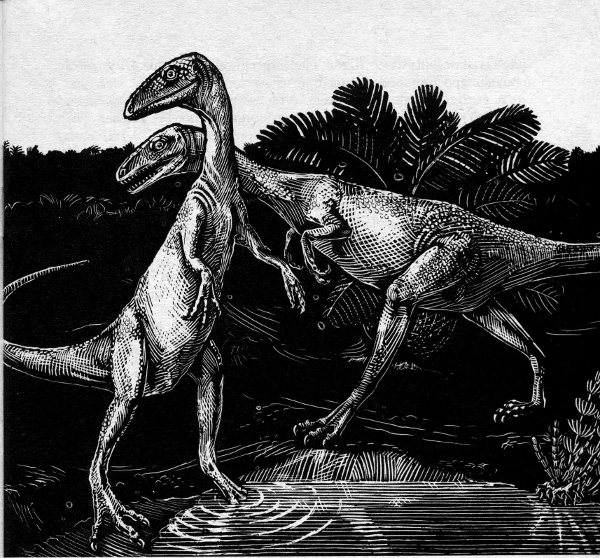
This seems a fitting analogy for what Berry means by language disconnected from its object. AI has the bones of human discourse, preserved in a vast graveyard of training data, but no firsthand experience of the reality those words describe. It can build a structure of argument, or description, or experience in the absence of the living thing.
The result is often shrink-wrapped prose.
But language can also depart from the world in another way, Berry notes, when we move out of the present tense in technical contexts, confidently predicting the future.7 By definition, those predictions cannot be held accountable under Berry’s second test, because they are made for a world that does not yet exist.
In a similar way, AI is generating text of a place that it is not in. We cannot be in the future, but an LLM cannot even be in the present, at least not as a responsible witness.
While dissecting a particularly bad sentence, Berry makes another observation: a sentence is not merely a container for an idea. It is “a way of thinking”8 about reality.
That distinction matters enormously. If writing is a form of thinking, then what are the consequences of using a sentence that you have not thought through? Or of making a claim that you have not first validated by your experience? Or taking on a position that you have not drawn to?
The problem is no longer simply that the machine is disconnected from reality. I have allowed my own words to become disconnected from my thinking.
The Cost of Effortless Prose
Berry often uses economic language, so let me try to cast it in similar terms.
What has collapsed is the cost of producing prose. What has not collapsed is the cost of comprehending, evaluating, and utilizing prose.
When you compose a dozen pages of thoughtless, computer-generated prose and push it out into the world, you are creating an incredible asymmetry. For the cost of virtually nothing, you have put it on the reader’s shoulders to understand, evaluate, and bring into usable form prose that you did not bother to understand, evaluate, or bring into usable form.
Berry writes that the “inescapable doom” of undisciplined language is “glibness.”9 One benefit of literary discipline, he argues, is that it slows language down enough to make it thoughtful. And the challenge can be a good thing. Every writer has had the experience of thinking you understand something right up until you try to explain it to someone else. Searching for the right word is useful friction. Wrestling with a claim and its evidence forces you to examine what you know and believe.
AI gives you fluency without friction. It allows you to create polished prose without requiring you to do any of the intellectual work that normally goes into producing it.
Of course, not all difficulty is necessarily useful. There is value in tools that help us read, think, and write. But is this what AI does? Does it only take away the unnecessary mechanical burden? Or does it also take away the necessary intellectual burden?
The Problem of Scale
Another of Berry’s main concerns about technology involves the question of scale. Drawing on C. S. Lewis’s The Abolition of Man, he argues that beyond a certain point, our individual technological choices begin to impose themselves upon others, particularly those who come after us.10
So it may be perfectly reasonable for you to use AI to compose a single piece of writing. But what if it makes it possible for you to produce hundreds of pages of writing faster than it is possible for another human being to thoughtfully read a single page?
This is not about whether an AI-generated text is useful or true. This is about the reality that human attention and judgment do not scale at the same rate as our capacity to generate content.
It would be tempting to end the analysis here, with a problem large enough to encompass an entire civilization. It becomes humanity’s problem, which is another way of saying that it is someone else’s problem.
But Berry’s argument will not allow us to shirk it in that way. He brings us back to the speaker, to the topics at hand, and to those who have to contend with the outcomes.
Speaking Where We Stand
Berry’s answer to the disintegration of language is love.
“[L]ove makes language exact, because one loves only what one knows.”11
AI is particularly good at generalization. But human language matters most when it is rooted in the particular: this person, this place, this thing I saw, this thing I did. The more closely our words are connected to things we know and love, the more accountable they become.
Berry closes by contrasting the speculative projection of the future with the accountable speech of making a promise. “We are speaking where we stand,” he writes, “and we shall stand afterwards in the presence of what we have said.”12
That, I think, is the question we ought to carry into our use of generative AI.
Are we willing to stand by our words?
This is the test Berry applied more than forty years ago to English textbooks and government transcripts. And it works just as well for me, right now, with a chat window open in the next tab.